

National Jaguar Policy and Strategy & Action Plan for Belize
Improving Scientific Communication with Efficient, Standardized, and Accurate Marine Data
Project Summary
The University of Belize Environmental Research Institute (UB-ERI) is supporting the Forest Department and national partners in the collaborative development of Belize’s National Jaguar Policy and Strategy & Action Plan. This work is part of the broader project titled "Enhancing jaguar corridors and strongholds through improved management and threat reduction," funded by the United Nations Development Programme (UNDP).
This initiative reflects Belize’s continued leadership in jaguar conservation and recognizes the species' role as a keystone and umbrella species critical to the health of the country’s rich forest ecosystems. Belize is one of the few countries in the region to maintain three functional biodiversity corridors that support viable jaguar populations. However, increasing threats from land-use change, habitat fragmentation, and human-wildlife conflict require a national, coordinated response.
The resulting National Jaguar Policy and Strategy & Action Plan will establish a coordinated framework for conservation action—defining clear roles and responsibilities, integrating monitoring and evaluation mechanisms, and guiding efforts to maintain genetic connectivity and reduce threats across Belize’s wildlands, directly supporting the country’s national biodiversity targets.

This initiative enhances the interpretation and communication of marine monitoring data in Belize, enabling stakeholders to engage with scientifically robust insights into marine ecosystem health.
Project Components
Develop In-House Prototypes
UB-ERI will create demo marine data tools and communication standards internally. These will serve as working examples to showcase the benefits of clearer, more efficient scientific communication using open-source and sustainable approaches.
Assess Current Communication Channels
We will critically evaluate how marine monitoring data is currently shared, interpreted, and visualized across Belize. This includes identifying gaps, bottlenecks, and opportunities for improved clarity and reach. Recommendations will be made based on findings.
Partner-Driven Customisation
UB-ERI will work directly with partner organisations to co-design and deliver customised tools and standards tailored to their unique marine data communication needs, supporting long-term data management and decision-making.
Methodological Approach
Open-Source Tools for Sustainable Impact
At UB-ERI, one of our core principles is long-term sustainability. To support this, we prioritize open-source software and coding practices when developing tools and standards. This ensures that marine data tools remain accessible to all, regardless of access to software. The code behind tools should also be open for partners to access, enabling them to maintain and modify these tools independently. Sustainability is all about present to future oriented solutions.
Key open-source platforms we use include:
-
Git – for version control and collaborative code development
-
R – for data analysis and visualisation
-
R Shiny – to build interactive, data-driven web applications
-
Visual Studio Code – to manage multi-file coding projects efficiently
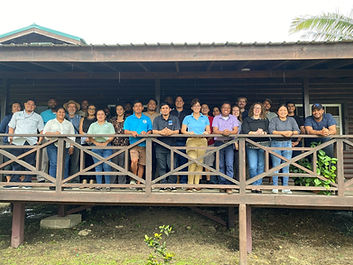
Marine Data Management Workshops to equip researchers and conservationists with essential skills for handling and analyzing marine data
Project Impact
Strengthening Reef Monitoring Communication in Belize
In 2024, the team reviewed the current approach for communicating AGRRA (Atlantic and Gulf Rapid Reef Assessment) reef-monitoring data in Belize, which is through the development of a healthy reef report card through the organization Healthy Reefs for Healthy People (HRHP). Alongside other reef-monitoring organizations in Belize that use the AGRRA methodology, several recommendations were made both to AGRRA and HRHP to better facilitate both data management prior to report card development, and the communication of data using the report card. To support interpretation of the AGRRA data used in the report card, the UB-ERI developed two chapters of supplementary materials for the 2024 Mesoamerican Reef Report Card. These describe methodology used to calculate coral reef health indicators, enabling transparency and replicability of the results and provide site-level visualisations of the data to help stakeholders interpret coral reef health indicator data used in the Report Card.
Later that year, the UB-ERI team wrote a brief for Belize partners and the interested public about what the report card means for Belize. The aim of this UB-ERI brief was to clarify some of the communication made in the report card and offer opportunities to deepen understanding of the data.
Demonstrating New Data Tools
In 2024, we created a public demo data dashboard using our open-access AGRRA reef monitoring data (accessible on Dryad) to show organizations an example of how their data could be presented in this format using R Shiny. We also created additional demo Shiny Apps to showcase other specific use cases, such as automatic report generation, or automatic figure generation and download. These additional demos are presented directly to organizations and are not made public.
Partnering for Practical Impact with TASA
In 2025, the UB-ERI partnered with Turneffe Atoll Sustainability Association (TASA) to design and deliver two marine data tools using R Shiny:
-
A public-facing dashboard (to be launched mid-2025) hosted on shinyapps.io for broader outreach and transparency.
-
An internal reporting tool that allows TASA staff to automatically generate customizable reports based on their marine monitoring data based on chosen timeframes and data types (deployed and accessed locally on TASA computers).
The goal of this collaboration was to assist TASA in improving the efficiency of data reporting and communication with their target audiences. TASA will be using the apps starting mid-2025, and UB-ERI will continue to work with them on developing/modifying the apps as needed to further improve them as tools for scientific communication.
Project Outputs
-
Boles, J. C., Muñiz, I., McField, M., Martinez, R., Snaddon J. L. (2024). Calculation of Reef Health Indicator Values. In: Online Supplement for the 2024 Report Card on the Health of the Mesoamerican Reef. www.healthyreefs.org
-
Boles, J. C., Muñiz, I., McField, M., Martinez, R., Snaddon J. L. (2024).Presentation of Indicator Value Data Visualizations. In: Online Supplement for the 2024 Report Card on the Health of the Mesoamerican Reef. www.healthyreefs.org
-
Boles, J. C., & Snaddon, J. L. (2024). From Data to Action: What the 2024 Healthy Reefs Report Card Means for Belize. University of Belize Environmental Research Institute. DOI:10.5281/zenodo.14232517

Marine researchers conducting AGRRA surveys at Turneffe Atoll Marine Reserve


Partners and Funders


